# Fourier Transform
## Before starting...
Let us start by taking a look into the results found in the previous chapter. We have defined the complex exponential Fourier series for a periodic signal $x(t)$ as:
$$x(t)=\sum_{k=-\infty}^{\infty}X_ke^{jk\omega_0 t}$$
with $\omega_0=2\pi f_0$ and $k\in\mathbb{Z}$ and complex coefficients found as
$$X_k=\frac{1}{T_0}\int_{-\frac{T_0}{2}}^{\frac{T_0}{2}}x(t)e^{-jk\omega_0 t}dt, \hspace{10px}k\in\mathbb{Z}$$
where the integration period $T_0$ is taken symmetrically about zero.
## Fourier Transform
When the period $T_0$ increases, the frequencies belonging to the Fourier series coefficients ($kf_0$) lie closer and closer together as $f_0=1/T_0$ decreases. Now, what if $T_0$ approaches infinity? That is, what would happen if we have an *a-periodic* signal?
Fourier coefficients will lie infinitesimally close to each other, so they define **continuous function of frequency**, $f\approx kf_0$

:::{card} Derivation
```{admonition} MUDE Exam Information
:class: tip, dropdown
This derivation is provided for additional insight and will not be part of the exam.
```
Substituting the definition of the series coefficients into $x(t)$, we find
$$x(t)=\sum_{k=-\infty}^{\infty}\left(f_0\int_{-\frac{T_0}{2}}^{\frac{T_0}{2}}x(t)e^{-jk2\pi f_0t}dt\right)e^{jk2\pi f_0t}$$
Now, when $T_0\to\infty$, $f_0$ becomes infinitesimally small, $f_0\to df$. Multiplying $f_0$ with $k$ then becomes a continuous function, $kf_0\to f$. The summation from $k=-\infty$ to $k=\infty$ then becomes an integration in $f$ from $f=-\infty$ to $f=\infty$
$$x(t)=\int_{-\infty}^{\infty}\left(df\int_{-\infty}^{\infty}x(t)e^{-j2\pi ft}\,dt\right)e^{j2\pi ft}$$
Re-arranging the terms:
$$x(t)=\int_{-\infty}^{\infty}\underbrace{\left(\int_{-\infty}^{\infty}x(t)e^{-j2\pi ft}\,dt\right)}_{X(f)}e^{j2\pi ft}\,df$$
:::
The integral between parentheses is defined as **Fourier integral** or (continuous-time) **Fourier transform**, $\mathcal{F}()$:
$$X(f)=\int_{-\infty}^{\infty}x(t)e^{-j2\pi ft}dt$$
The complex number $X_k$ of the Fourier series is now a complex **function** of the frequency, $f$: $X(f)$.
The **inverse Fourier transform**, $\mathcal{F}^{-1}()$ can also be derived
$$x(t)=\int_{-\infty}^{\infty}X(f)e^{j2\pi ft}df$$
```{note}
To obtain $x(t)$ from $X(f)$, we integrate over frequency, $f$, and the result is a function of time, $t$
```
Hence, Fourier transform and its inverse can be used to transform time signal to the frequency domain, and the other way around. This yields a **Fourier transform pair**:
$$x(t)\xrightarrow{\mathcal{F}}X(f)\xrightarrow{\mathcal{F}^{-1}}x(t)$$
### Conditions
**Sufficient** conditions for convergence of Fourier transform integrals are:
* $x(t)$ absolutely integrable, i.e. $\int_{-\infty}^{\infty}|x(t)|dt<\infty$
* discontinuities, if any, should be finite
### Amplitude and phase
Like the coefficients of complex Fourier series, a Fourier transform can also be written in terms of **magnitude** and **phase**:
$$X(f)=|X(f)|e^{j\theta(f)}$$
with
$$\begin{gather*}|X(f)|=\sqrt{\left(\text{Re}(X(f)) \right)^2+\left(\text{Im}(X(f))\right)^2}\\ \theta(f)=\arctan\left(\frac{\text{Im}(X(f))}{\text{Re}(X(f))}\right)\end{gather*}$$
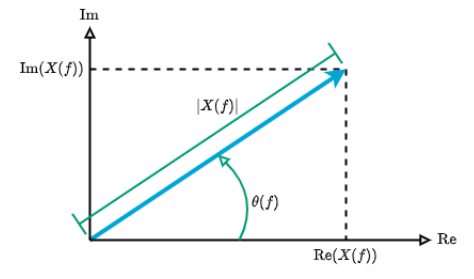
When $x(t)$ is real, we have $X(f)=X^*(-f)$, and then
$$|X(f)|=|X(-f)|\hspace{10px}\text{and}\hspace{10px}\theta(f)=-\theta(-f)$$
* Magnitude $|X(f)|$ is an **even** function of $f \to$ **amplitude spectrum**
* Phase $\theta(f)$ is an **odd** function of $f \to$ **phase spectrum**
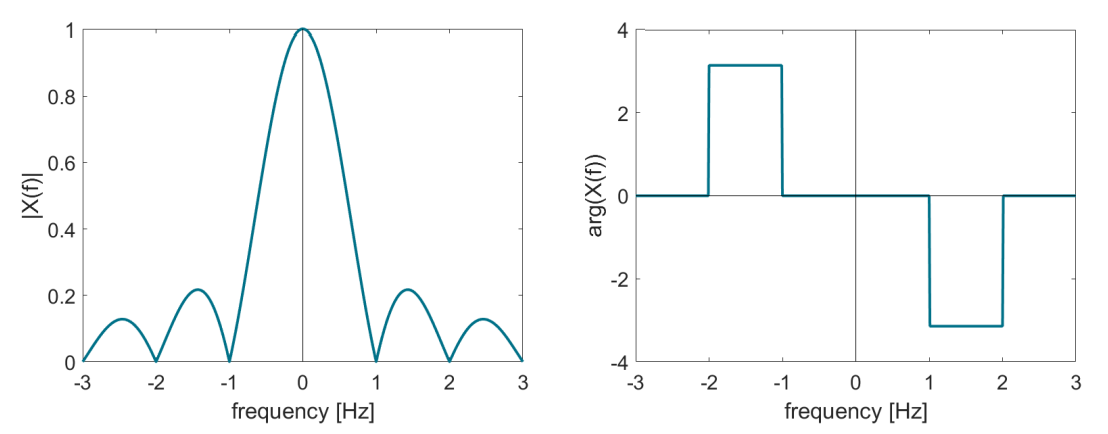
The figure above illustrates an example of $|X(f)|$ and $\theta(f)$ both as a function of frequency.
## Summary
A-periodic functions can be written as integrals, **continuous** over **frequency**. This yields the so-called **Fourier transform** (and its inverse):
$$\begin{gather*}X(f)=\int_{-\infty}^{\infty}x(t)e^{-j2\pi ft}dt\\ x(t)=\int_{-\infty}^{\infty}X(f)e^{j2\pi ft}df\end{gather*}$$
Amplitude and phase spectrum are given by:
$$\begin{gather*}|X(f)|=\sqrt{\left(\text{Re}(X(f)) \right)^2+\left(\text{Im}(X(f))\right)^2}\\ \theta(f)=\arctan\left(\frac{\text{Im}(X(f))}{\text{Re}(X(f))}\right)\end{gather*}$$
## Exercises
:::{card} Fourier Transform Exercise (1 of 2)
The signal $x(t)=\Pi(\frac{t}{\tau})$ is defined by a pulse function with duration $\tau$ [s]:
$$
\Pi\left(\frac{t}{\tau}\right) =
\begin{cases}
1, & \text{for $-\frac{\tau}{2} \leq t \leq \frac{\tau}{2}$}.\\
0, & \text{otherwise}.
\end{cases}
$$
Derive an expression for the Fourier transform $X(f)$ of signal $x(t)$.
_Hint: you may want to use Euler's formula to turn the difference of two complex exponentials into a sine function. In addition, to turn your answer into an even more compact form, you may want to use the cardinal sine, which is defined as $\textrm{sinc}(z)=\frac{\sin(\pi z)}{\pi z}$._
````{admonition} Solution
:class: tip, dropdown
The video below illustrates how to arrive at the final solution, which is presented here:
$$
X(f) =
\tau \,\textrm{sinc}(\tau f)
$$
```{eval-rst}
.. raw:: html
```
The solution can also be found using SymPy:
```python
import sympy as sym
```
```python
t = sym.symbols('t')
tau, f = sym.symbols('tau, f', positive=True)
x = sym.Piecewise((0, t < -tau/2), (1, t < tau/2), (0, True))
display(x)
```
$\begin{cases} 0 & \rm{for}\: t < - \frac{\tau}{2} \\1 & \rm{for}\: t < \frac{\tau}{2} \\0 & \rm{otherwise} \end{cases}$
```python
solution = sym.integrate(x*sym.exp(-sym.I*2*sym.pi*f*t), (t,-sym.oo,sym.oo))
simplified_solution = sym.simplify(solution)
display(solution)
display(simplified_solution)
```
$- \cfrac{i e^{i \pi f \tau}}{2 \pi f} + \cfrac{i e^{- i \pi f \tau}}{2 \pi f}$
$\cfrac{\sin{\left(\pi f \tau \right)}}{\pi f}$
````
:::
:::{card} Fourier Transform in the Limit Exercise (2 of 2)
Given the Fourier transform $X(f)=\delta(f)$, find the expression for signal $x(t)$. Then, verify the following two points:
1. When $x(t)=e^{j2\pi f_0 t}$, then $X(f)=\delta(f-f_0)$, and
2. When $x(t)=\cos(2\pi f_0 t)$, then $X(f)=\frac{1}{2}(\delta(f-f_0)+\delta(f+f_0))$.
_Hint: for the first part (finding $x(t)$), use the *inverse* Fourier transform, and use the sifting property of the Dirac delta function (in this case in the frequency domain) when solving the integral._
````{admonition} Solution
:class: tip, dropdown
The video below illustrates how to arrive at the final solution, which is presented here:
$$
x(t) = \cos (2\pi f_0 t)
$$
```{eval-rst}
.. raw:: html
```
````
:::
% START-CREDIT
% source: signal_processing
```{attributiongrey} Attribution
:class: attribution
This chapter is written by Christiaan Tiberius. {ref}`Find out more here `.
```
% END-CREDIT